
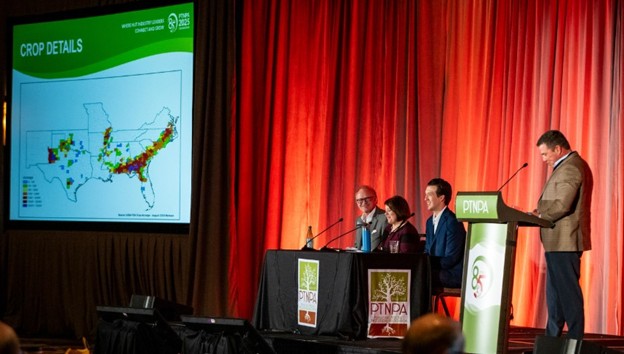
Seated L-R Alex Izmirlian, Premium Peanut, Anne-Marie DeLorenzo, Mars Wrigley, Nick Smith, along with Moderator and fellow Peanut Broker, Collins McNeil of M.C. McNeill & Co., update attendees during the Peanut and Tree Nut Processors Association Convention.
By Nick Smith, R Smith Nut Company
When most people hear the word “broker,” they might think of Wall Street, real estate, or high-powered business deals. But in peanuts, a broker serves a very different—and, in my view, essential—role.
Our industry begins and ends with the grower. Everything that happens downstream—shelling, brokering, manufacturing—only exists because of the hard work that happens in the field. Without your crop, there’s no product to process, no jars to fill, and no bags to ship.
That’s why I see my work as a broker not just as a business, but as a partnership with growers. My job is to help connect the peanuts you produce to the right buyer at the right time, ensuring our supply chain continues to move and demand for the product you produce remains steady, allowing you to keep your operation moving forward.
My path to the peanut business
I was born into the peanut industry in Suffolk, Virginia, grew up in Raleigh, North Carolina, and now call Austin, Texas, home. My parents, Rusty and Tina Smith, built our family brokerage from the ground up, and thanks to their dedication, I’ve had the privilege of meeting growers across every U.S. peanut-producing region.
I’ve also seen our peanuts make their mark around the world—meeting U.S. Ambassador to Japan George Glass in Tokyo, touring the port of Rotterdam where American peanuts arrive in Europe, and yes, even meeting Shaquille O’Neal at you guessed it, a peanut conference.
After graduating from Elon University, my parents gave me a chance—despite my lack of direct experience—to prove I could help the business. Like many family operations, it hasn’t been without challenges, but the rewards of working in this industry far outweigh those challenges.
What a peanut broker does for growers
Every broker works a little differently. Some represent only sellers, others only buyers, and some focus on specific varieties or origins. At R Smith Nut, we take a broader approach. We work with a wide range of sellers and buyers, from small operations to some of the largest in the industry. For some manufacturers, we help them minimize time spent on the entire peanut process, from purchasing and logistics to formulation. For some sellers, we help them confidently move peanuts so they can focus on other areas of their operation. We pride ourselves on being a full-service brokerage that both buyers and sellers rely on.
Other benefits of brokers include market access and connecting new and diverse buyers. Market insight keeping a close watch on supply, demand, and price trends to help each part of the industry stay abreast of opportune times for sales. Negotiation support to ensure our clients receive competitive terms and that the sale works for both parties. Logistics assistance by coordinating transportation and smoothing out delivery schedules; we handle details that can otherwise become headaches.
Our role is to ensure your crop moves efficiently and profitably, allowing you to focus on what you do best: growing it. No day is ever the same in our world, just like no crop is ever the same for the grower, or no year ever shells the same for the sheller. I appreciate that part of our business. As a broker, we thoroughly analyze all aspects of the supply chain to understand the market for our industry.
Why the market changes daily
A big part of my job is tracking the variables that affect demand and price:
- Weather patterns and their impact on yields
- International buying interest—Will China step in as a major purchaser this year?
- Related commodity markets—How will cocoa prices affect peanut candy demand?
We read these signals so we can share what’s happening now and what might be coming next, helping shellers and thus growers plan with confidence.
Advocating for the peanut industry
Brokers also have the advantage of seeing the industry from a bird’s-eye view, which puts us in a good position to be advocates. Whether it’s promoting U.S. peanuts overseas, supporting marketing campaigns here at home, or sharing the growers’ story with industry decision-makers, we’re working to keep peanuts competitive in the marketplace.
Challenges—and opportunities—on the horizon
One of our most significant opportunities is to keep telling the peanut story. The peanut allergen worry is a significant concern, but we are making progress in highlighting the importance of early introduction. Peanuts are healthy, versatile, affordable, and delicious. Those are qualities worth repeating—loudly.
Plant-based protein is another major growth area, and peanuts belong in that conversation. Many younger consumers are blending their meals into smoothies. Peanut butter should be the default protein base for this trend. In my own home, peanut butter, banana, and chocolate are a go-to smoothie combination—it’s nutritious, filling, and tastes almost too good to be healthy.
And of course, there’s the classic snack appeal. A salted peanut at the ballpark or on the porch isn’t just food—it’s an experience, and that connection matters to consumers.
Why I’m grateful for growers
At the end of the day, every deal I broker starts with your hard work in the field. Without growers, the rest of us—shellers, brokers, manufacturers—don’t have a product to move. I’m proud to work in a role that supports your success and helps bring what you produce to market.
By Nick Smith, R Smith Nut Company
