

Peanut Ring Nematode Populations vs Aflatoxin
SARALA GIRI, JOHN MULLER, HEHE WANG, SALEH AHMED AND DANIEL ANOCO
BLACKVILLE, SOUTH CAROLINA
Peanut production is affected by many soil-borne pathogens, which reduce peanut yield and quality. Among many important pathogens is the Peanut ring nematode (Mesocriconema ornatum), a microscopic worm capable of causing necrotic lesions on pods, pegs, and roots. Peanut ring nematode does not always cause obvious aboveground symptoms. The feeding, however, can expose peanut to other pathogens. This exposure caused by ring nematode has been reported to result in greater yield and quality losses.
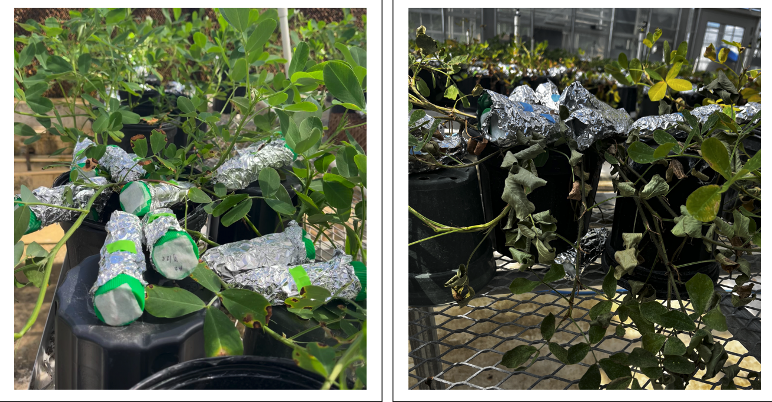
One of the major problems in peanut production is a toxin called aflatoxin, produced by the fungus Aspergillus flavus under hot, drought-stressed conditions. This mycotoxin remains problematic for global health and the economy, as it can cost the peanut industry up to 126 million USD annually, as recorded by Lamb (2021). This toxin is harmful to human and animal health; therefore, there are strict limits on its presence in peanuts and peanut products. The maximum acceptable limit of aflatoxin for human consumption is < 20 ug/kg for the USDA and < 5 ug/kg for the European Union. These can lead to peanut seed lot rejections in the US and trade restrictions in European countries. Management of aflatoxin has become significantly challenging because processes such as cooking, drying, sterilization, and pasteurization have no effect on aflatoxin reduction. Previous research has suggested that insect and nematode feeding can expose peanut to other pathogens. And because peanut ring nematode feeding causes necrotic lesions on pods, pegs, and roots, they might create a pathway for Aspergillus infection and aflatoxin contamination. Due to the presence of high numbers of ring nematodes in peanut fields in South Carolina and at the Edisto REC, the relationship between peanut ring nematode and aflatoxin was questioned and studied in irrigated and non-irrigated fields, as well as in the greenhouse at the Edisto REC, Clemson University. Pesticides were applied to encourage varying ring nematode densities to study ring nematode numbers and their relationship with aflatoxin contamination. Nematode numbers increased over time despite the pesticide applications. Several pesticides with active ingredients such as 1,3-dichloropropene, fluopyram plus prothioconazole, fluopyram, and aldicarb have been labeled and recommended for nematode management in peanut (Anco et al. 2024). Most recommendations, however, are for nematodes as a general group rather than for specific nematode species. In our experiments, many nematicides, alone or in combination, had little to no effect on recovered populations of the ring nematode (M. ornatum). The peanut ring nematode was found to be a minor pathogen of peanut, as it did not affect peanut yield or quality in a significant way at harvest. The pod yield was slightly increased in the presence of ring nematodes, potentially suggesting the possibility of an indirect benefit such as might be a feeding-induced defense response against other pests. In theory, pesticides that help manage insect feeding, which could create an entryway for Aspergillus, and fungicides that kill or inhibit the fungus directly can help inhibit or reduce subsequent aflatoxin accumulation. In the field, tested pesticides applied near planting or pegging in this study were ineffective overall in controlling aflatoxin levels at harvest, and peanut ring nematode was not consistently associated with Aspergillus colonization as well as aflatoxin production in both field and in greenhouse. It was also observed that soil moisture plays an important role in ring nematode multiplication and aflatoxin reduction. Soil moisture cannot, however, be used as the sole decisive factor in making recommendations. The low aflatoxin levels in an irrigated field have been related as associated to phytoalexin production, which inhibits Aspergillus colonization and aflatoxin production as part of the defense response in peanut at high soil moisture levels. This study showed that aflatoxin production remains a complex, multifaceted process.
References:
Anco D., Marshall M., Kirk K.R., Plumblee M.T., Smith N., Mickey S., Farmaha B., and Payero J. 2024. Peanut Money-Maker 2024 Production Guide. Circular 588. Clemson University Extension: Clemson, SC, USA.
Giri, S. Mueller, J. Wang, H., Ahmed, S., & Anco, J. (2025) Effects of Pesticides on Peanut Ring Nematode Quantities and Subsequent Effects on Yield and Aflatoxin Contamination in Peanut. Peanut Sci. 52:170-186.
Lamb M.C., Sorensen R.B., and Butts C.L. 2021. Cost of aflatoxin to United States peanut industry (Lamb). APRES annual meeting presentation [Internet]. YouTube: APRES; [cited 2025May11]. Available from: https://www.youtube.com/watch?v=vrXQ91B00gY&t=23s&ab_channel=APRES. ∆
SARALA GIRI, JOHN MULLER, HEHE WANG, SALEH AHMED AND DANIEL ANOCO
AMERICAN PEANUT RESEARCH AND EDUCATION SOCIETY
Link to Original Story: https://peanutscience.com/article/id/1656/
