

Written by: Sarah Sharman, PhD / www.hudsonalpha.org
The humble peanut sustains millions of people across continents, from Africa’s arid fields to Asia’s humid farms. It is a source of income, nutrition, and cultural identity. Yet whether in a village in Malawi or a homestead in South America, farmers face the same fragility: a single drought or outbreak of disease can erase a season’s work and jeopardize food supplies for entire communities.
While these challenges are global, the solutions are becoming intensely local. In the heart of Alabama’s Wiregrass region, the self-proclaimed peanut capital of the world, the traditional grit of the American farmer is meeting the cutting edge of genomic science.
The Fragility of the Farm
On a June morning in Alabama’s Wiregrass region, the horizon shimmers with heat as peanut fields stretch in perfect, leafy rows. To the casual observer, it is a serene landscape. To the farmer, each plant represents months of calculated risk: tilling, planting, irrigation, pest management, and riding out the weather.

“Imagine working hard day and night for months only to have your livelihood destroyed by something you can’t even see,” said a local Wiregrass farmer. That reality, he explains, connects Wiregrass growers to peanut farmers in Malawi, India, and Argentina. The line between a profitable year and a total loss can come down to the same invisible threats: drought, fungi, and heat.
William Birdsong, an agronomist who has spent three decades helping Alabama farmers, has seen it all. “We’ve certainly made tremendous gains in technology,” he says, “but the risks remain high.” He ticks off a long list of threats from aflatoxin to the lesser cornstalk borer, a pest so small it tunnels through the pods, opening a gateway to fungus and toxins. “At the end of the day,” Birdsong says, “farmers everywhere are still subject to what Mother Nature decides.”
For generations, traditional breeding and improved management practices were the only tools to confront these risks. But with volatile weather patterns and new pathogens on the rise, growers are seeking solutions faster than nature can provide them. The answer is no longer just in the soil; it is in the genetic code.
The Genomic Solution: Bespoke Peanuts for the Wiregrass and Beyond
In a bright lab inside the Wiregrass Innovation Center, scientists from the HudsonAlpha Institute for Biotechnology are reading the peanut’s DNA code letter by letter, a code roughly twice as large as the human one. This is the heart of the HudsonAlpha Faculty Investigator Dr. Josh Clevenger’s work. The team uses an approach called “genome-directed breeding,” and the goal is ambitious: tailor-made, or “bespoke,” peanut varieties built to thrive in the Wiregrass’s unique soils, weather, and peanut pressures.
“This is about turning natural genetic variation into resilience,” says Clevenger. “When we pinpoint genes or genetic changes that provide drought tolerance or virus resistance, we can help breeders everywhere choose parent plants that pass along those strengths.”
Their process mirrors the meticulous selection that farmers have practiced for centuries, but “turbo-charged” by data. Instead of waiting generation after generation to see outcomes in the field, scientists can now scan DNA for markers linked to drought tolerance or disease resistance, then hand breeders a shortlist of parent plants likely to pass on those traits.
The results already reach far beyond Alabama. The Clevenger lab identified genetic contributors that confer resistance to peanut smut, a soil-borne fungus that has devastated crops in Argentina. Similarly, they pinpointed genetic variation linked to resistance to tomato spotted wilt virus, one of the Southeast’s most persistent yield killers. These discoveries are being incorporated into international breeding programs to strengthen local varieties worldwide.

While these challenges are global, the solutions are becoming intensely local. In the heart of Alabama’s Wiregrass region, the self-proclaimed peanut capital of the world, the traditional grit of the American farmer is meeting the cutting edge of genomic science.
Tangible Outcomes Beyond the Harvest
For all its technical sophistication, the peanut genomics effort is as much about people as it is about plants. In late 2022, HudsonAlpha announced a partnership with the city of Dothan to expand its footprint to the Wiregrass region of southeast Alabama. By embedding high-tech enterprise in a largely agricultural region, HudsonAlpha Wiregrass is reshaping how rural communities see science, and how science can serve them.
“Biotechnology isn’t just for scientists in white coats somewhere far away,” says HudsonAlpha computational biologist Catherine Davis. “It can be an economic and educational lifesaver here at home.”
That local impact is visible in Dothan’s growing ecosystem of researchers and agtech innovators who might once have felt forced to move to California or Boston for this level of work. Through the Wiregrass Peanut Project, local high school students are now learning DNA extraction and bioinformatics modules in their own classrooms, planting the seeds for the next generation of scientists working to future-proof global food systems.
Mark Saliba, the mayor of Dothan, sees this as a defense against “brain drain.” “For young people from the Wiregrass region to see high-skilled, high-wage jobs right here–that’s huge,” says Saliba. “It’s verification that what we’re doing matters and helps solve real-world problems.”


Resilience, Rooted in DNA
Standing in the research fields in Headland, Alabama, you can see how small genetic differences translate to survival. One row of plants stays green through a spell of dryness, while another withers. That simple difference, powered by genetic markers identified in HudsonAlpha’s labs, is proof of what adaptable crops can achieve.
Peanut breeders used to think in decades. Now, with genomic tools, we can think in seasons.
Josh Clevenger, PhD
“Peanut breeders used to think in decades,” Clevenger says. “Now with genomic tools, we can think in seasons.” The speed matters. When an invasive pathogen pops up, or rainfall patterns change, the difference between a field failure and a bumper harvest could rest on how quickly researchers and growers can respond.
This agility is vital. Peanuts are naturally nitrogen-fixing, meaning they enrich soils even as they nourish people. Making them more resilient supports global sustainability by reducing fertilizer use, preserving yields, and protecting fragile ecosystems.
From the Wiregrass to the World
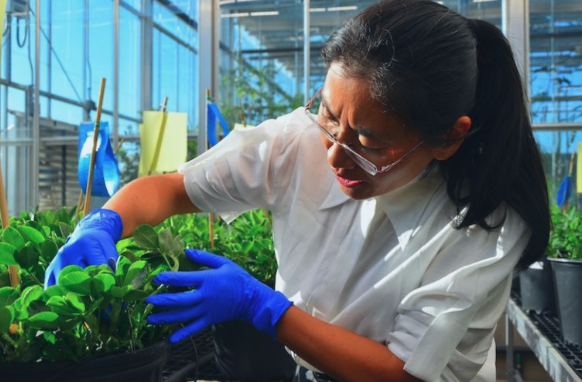
Back under the Alabama sun, the hope is tangible. HudsonAlpha’s Kathy L. Chan Greenhouse is filled with trays dotted with the next generation of carefully tracked peanut seedlings. Each is a living experiment in resilience, a small, coded promise that the next season might be a little easier, the next harvest a little safer. What starts here in Alabama will influence peanut breeding efforts across continents.
For the region’s farmers, that promise can mean staying on the land their families have worked for generations. For agricultural policymakers, it’s evidence that investment in genomic research pays off, not only in scientific discovery but in economic security. And for anyone who has ever enjoyed a handful of roasted peanuts or packed a PB&J into a lunchbox, it’s proof that innovation, rooted in community and soil, can safeguard a global food we often take for granted.
As Birdsong puts it, “We’ve always had to adapt. Now we finally have the science catching up with the farmer’s instincts.”
In the Wiregrass, that partnership between old knowledge and new technology might be the recipe for the world’s next great peanut, one built not only to survive but to sustain the people who depend on it.
