TAYLOR MOCK CUNNINGHAM, TERRY W. GRIFFITH, ELIZABETH A. YEAGER AND BRIAN K. COFFEY
URBANA, ILLINOIS
The USDA National Agricultural Statistics Service (NASS) publishes weekly Crop Progress and Condition reports for selected crops throughout each growing season, providing stakeholders with timely information on crop health across major producing states. For corn and soybeans, the relationship between these ratings and final yields is well established, with research demonstrating that the combined percentage of the crop rated in Good or Excellent condition becomes a reliable yield predictor by mid-July for corn and mid-August for soybeans (Irwin and Good 2017b, 2017a; Li et al. 2026). Peanuts, however, are a privately traded commodity with limited published yield-forecasting research, despite being the seventh most valuable U.S. field crop (USDA NASS 1999). For peanut stakeholders, a critical question is how early these weekly USDA snapshots can reliably predict what will eventually arrive at the buy points and shellers. This work extends to peanuts the methodological framework applied to corn and soybeans by Irwin and Good (2017b) and Irwin and Hubbs (2018) and draws directly from Cunningham (2026).
Background
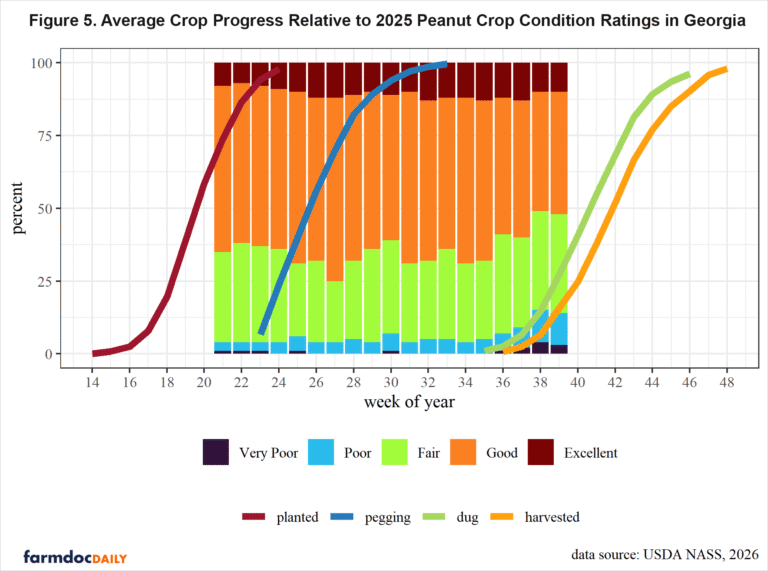
The USDA Crop Progress and Condition Report classifies the growing crop into five categories, Very Poor, Poor, Fair, Good, and Excellent, with percentages summing to 100. Reports specific to peanuts are published weekly from approximately May through October. As a recent example, Figure 1 illustrates the distribution of 2025 Georgia peanut crop condition ratings throughout the growing season.
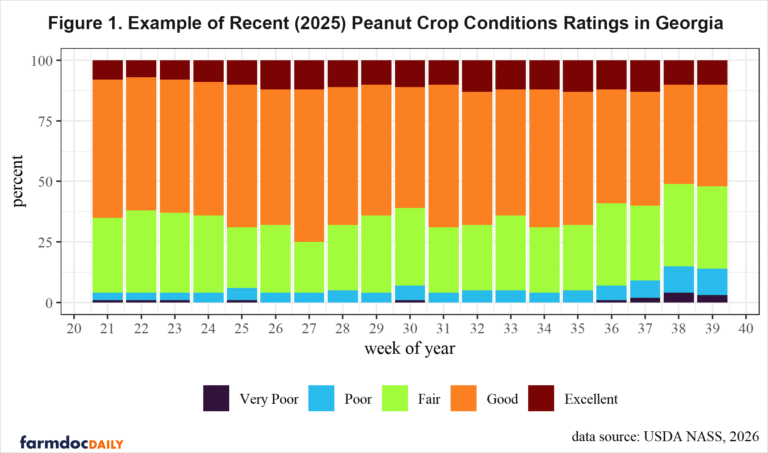
The standard approach for converting corn and soybean condition ratings into an index for mid-season yield forecasts is the Good plus Excellent (G + E) percentage, simply the sum of the two highest condition categories (Irwin and Good 2017b; Li et al. 2026). We adopt this benchmark here. For each calendar week w and state s, the forecasting model is estimated by ordinary least squares:
where t indexes crop year, G + E are percentage of acreage rated at sum of Good and Excellent.
Analysis
Yield and crop condition data were obtained from the USDA NASS QuickStats database for the six states producing the majority of U.S. peanuts: Georgia, Alabama, Florida, North Carolina, South Carolina, and Texas (USDA NASS 2026). A test for structural breaks in long-term peanut yields identified 2012 as a natural break, coinciding with the widespread commercial adoption of the high-yielding Georgia-06G cultivar. Therefore, yield and crop condition rating observations prior to 2012 were excluded, restricting the analysis to 2013 to 2025. After this break, yield trends across the six states are approximately flat, so no trend adjustment was applied. Summary statistics for this period appear in Table 1.
Table 1. A Decade of Peanut Yield Production, 2013 to 2025 (pounds per acre)
|
When do crop condition ratings become informative?
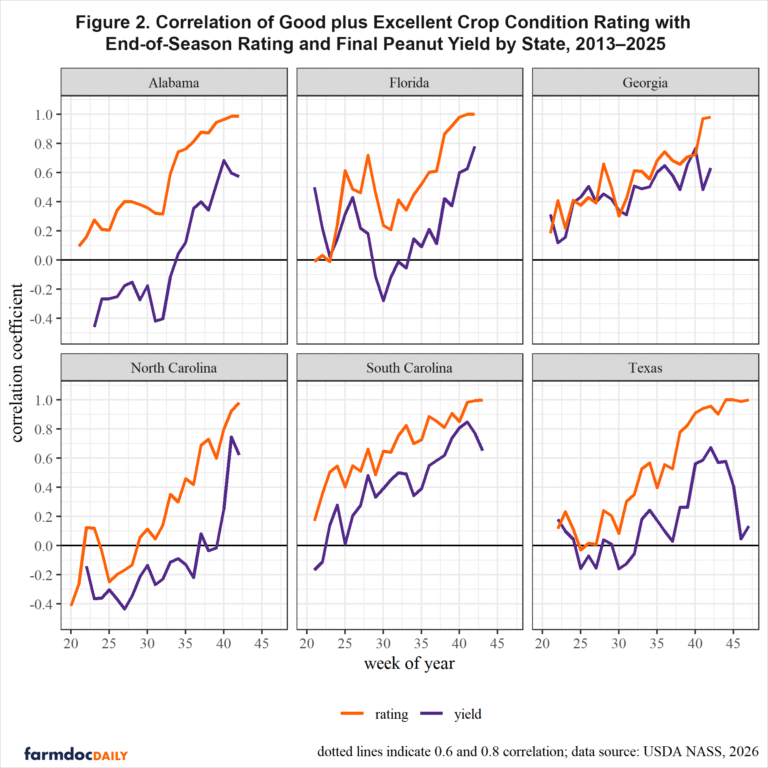
Figure 2 shows the correlation between the weekly Good plus Excellent rating and two endpoints, the final Good plus Excellent rating of the season and the final observed yield, for each of the six major peanut-producing states, over the 2013–2025 period. The pattern is qualitatively consistent with what Irwin and Good (2017b) found for corn and soybeans: correlations are low and unstable early in the season, then rise as the growing season advances.