


Contributing Editor
The peanut market is quiet as firmer prices and lack of demand remains. Most analysts believe that markets will be this way through the New Year as shellers and farmers prepare for new crop contracting. The industry is ending a good year with excellent quality and respectable yields that will supply manufacturing, which has slowed a bit from the record-setting numbers in domestic and export use.
Buying of U.S. peanuts by China has slowed. No Chinese purchases of raw-shelled peanuts were reported last month, and September purchases of in-shell peanuts were down 83% compared to last September.
Even domestic usage has dropped almost 3% the first three months of the marketing year with peanut butter down 4.3%. Most analysts had predicted that peanut butter consumption would slow as people began eating out again.
Guard Against Oversupply
What about 2022? Farmers are seeing higher prices on every input. From fertilizer to seed, increasing farm expenses are the ominous thunderstorm threatening to rain on healthy farm profits this year. Farmers will have to tighten their management skills by evaluating each commodity and the true cost of production. Then, based on market prices and costs, you can decide what crop to plant.
Some farmers argue that they can plant peanuts cheaper than cotton. Another farmer says if you grow by the Extension’s budgets, the cost per acre will be about the same, depending on how much irrigation is needed. Don’t forget fuel costs, and pray that a tractor or other machinery doesn’t break down.
While you might not be able to control inflation, you can control your response. Be proactive in protecting your operation from higher costs.
What about price? Shellers will not pay higher prices for farmer stock if manufacturers won’t support it for shelled goods. Everybody sees what higher input costs are doing to all parties. The last thing we need is for farmers to plant too many acres and have the market oversupplied.
Crop Totals
U.S. peanut production for 2021 is forecast to be 3.1 million tons, a 1% increase. Harvested area is now estimated at 1.5 million acres, down 5.1% from 2020. The average yield is forecast at 4,072 pounds per acre, a 7.3% increase over the previous year.
Market demand or disappearance totals 3.18 million tons, a 4.4% decrease. Domestic food usage is forecast to be up 3%. Exports are expected to decrease by 1.2% to 700,000 tons. Crushing for oil and seed dropped 14.5%. Ending stocks will be 974,000 tons, down from last month’s 996,500 tons.
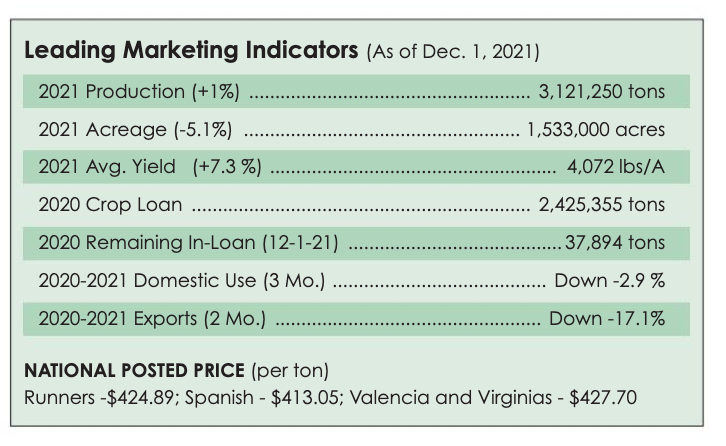 The peanut program loans totaled 2.4 million tons. As of December, only 37,894 tons were yet to be redeemed before the end of February 2022. That is good news for peanut farmers because it means program costs will be minimal.
Payments from the price loss coverage program are made when the market year average is below the reference price. The average is based on the prices paid to farmers from August 2020 to July 2021. The average last year was $430 per ton applied to 85% of the farm base tonnage. Payments totaled $365 million.
Export Update
Demand from China has diminished recently on the back of plentiful inventories in the country and its ongoing harvest. Manufacturers report that there is a lot of competition for ocean freight container space, and higher-priced products are getting preferential treatment over less expensive products such as agricultural commodities.
This situation is likely to drive peanut prices higher, but it is worth bearing in mind that peanuts remain a good value. It works to the industry’s advantage that peanuts are a plant-based protein source.
The biggest and most consistent markets for U.S. peanuts, outside of China, are Canada and Mexico. Fortunately, these markets don’t rely on ocean freight like other export markets. We can ship peanuts by rail, which has fewer issues than trucking.
The United States and the European Union reached a trade agreement on steel and aluminum that will allow for the removal of tariffs on more than $10 billion worth of exports each year, including peanuts.
Don’t Rock The Boat
There may be problems at every turn: politically, at the border, with gas prices, run-away-inflation,…the list goes on. However, peanut producers must remember, you are growing a plant-based, high-protein food that helps improve memory, cures hunger, is good for preventing heart disease and is a recognized superfood.
Farmers balanced production and demand with some government protection this year, but we need to keep the boat moving forward. The building and expansion of the industry’s infrastructure signals a bright future.
Keep your rotation in place. Watch for increasing costs, and I can’t emphasize this too much, with the Farm Bill in the balance, let’s not overplant the 2022 peanut crop.
