

DAVID JORDAN
RALEIGH, NORTH CAROLINA
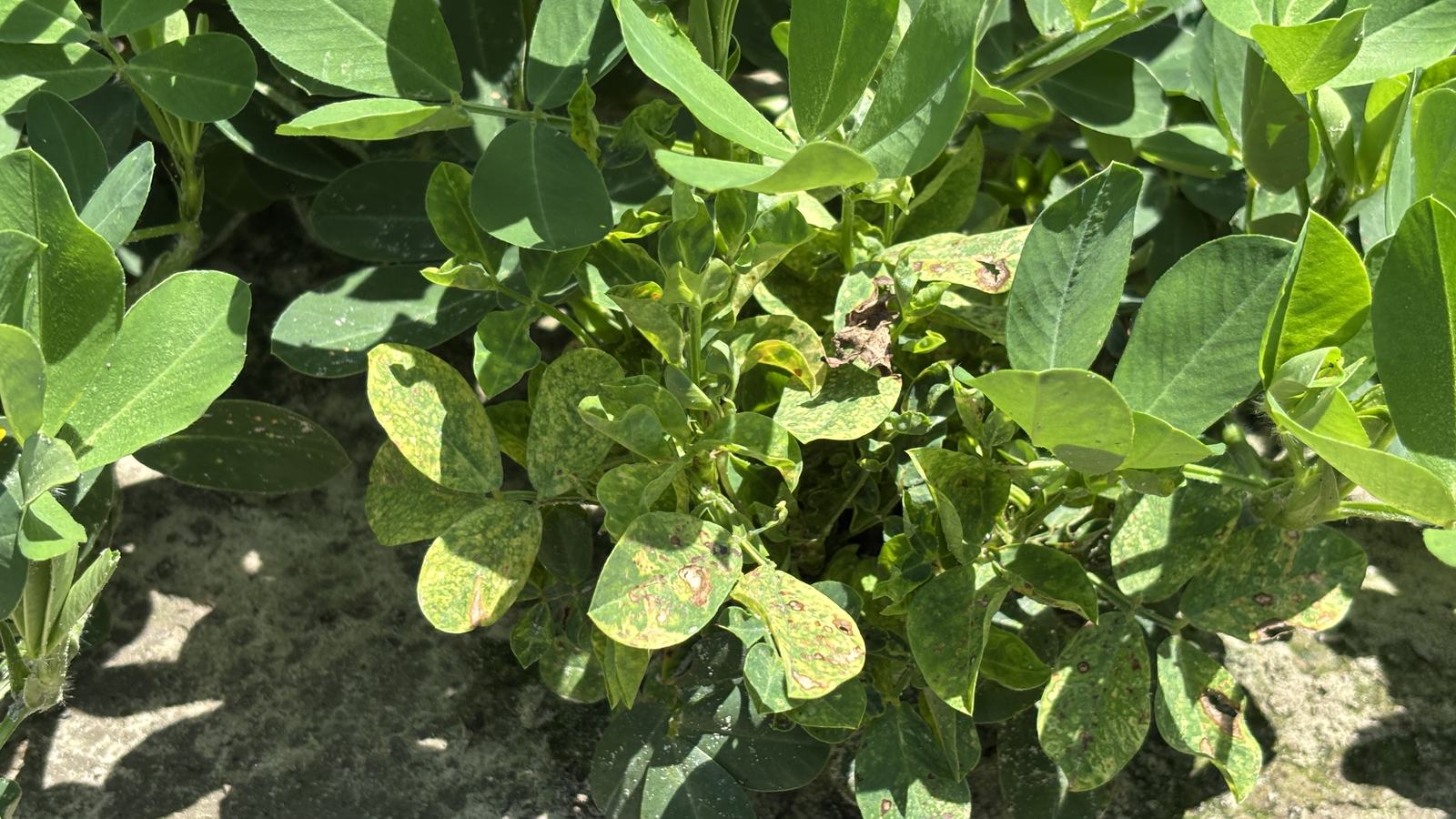
Higher Levels of Tomato Spotted Wilt in 2025?
Towards the end of the growing season last year, I heard a bit more discussion about farmers seeing more tomato spotted wilt than they were used to seeing. I certainly noticed more in some of our trials, but that was often associated with lower plant populations and varieties we don’t grow in NC that are considered susceptible to this disease. I do think some of our practices of late are contributing to greater risk of spotted wilt. Here are my thoughts.
-
We are planting earlier in recent years than we used to. Not everyone, but a significant number of people. Planting around the middle of May is when we think we have the least amount of risk. As the peanuts come up later in May, we tend to have lower numbers of thrips transmitting the virus.
-
While many people have increased seeding rates to ensure stands of 4-5 per foot, sometimes peanuts emerge slowly and inconsistently when planted earlier. When plants don’t emerge at the same time, the ones that come up first, are often prone to greater thrips damage and more virus. Thrips are going to find something to eat, and the plants that are up will be the target with a lot of thrips ganging up on the emerged plants.
-
When planted early, peanuts have trouble outgrowing the damage from thrips. They just don’t take off. You can make a stand, but the plants will sit there until you get enough heat units for the plants to get going. There’s more time for feeding and vectoring of the virus.
-
We still use a lot of imidacloprid in North Carolina. Our last survey showed about 70% of growers in both North Carolina and Virginia use it. We also know that imidacloprid is, in many fields, less effective than it was a decade ago. Resistance has been documented in North Carolina. Imidacloprid still suppresses thrips and protects peanuts from injury, but when I rate injury from thrips after this insecticide, I often see more thrips damage than I used to. Control can be inconsistent. With less-than-ideal control, thrips have a longer period to feed and transmit virus.
-
We continue to use a lot of imidacloprid because the generic formulations are numerous and inexpensive. Often, if we can get some level of control for a couple of weeks and then follow up with an acephate spray, we can get enough suppression of thrips to protect yield. This approach is relatively inexpensive and often “good enough.”
-
We do have resistance to acephate in some thrips populations across the state. Resistance has been confirmed in cotton, and the thrips found in cotton are feeding on peanuts as well. Dominic and I have discussed this, and we think that a shift to Hemi (spinetoram) with surfactant is a good approach. One reason we might have more spotted wilt, is because we get marginal control of thrips with imidacloprid followed by less control of acephate-resistant populations with foliar sprays. The next thing you know, you have given thrips well over a month to survive and feed on peanuts and transmit virus. Hemi, while more expensive, allows you to control the acephate-resistant populations that might be in your production area. Hemi works as well as acephate on non-resistant populations.
-
Research in the southeastern US has demonstrated that spotted wilt is greater when imidacloprid is applied compared with other insecticides. Imidacloprid causes something to happen physiologically to make peanuts more susceptible to the virus. The mechanism is unknown to my knowledge. So why have we been successful using imidacloprid in North Carolina and Virginia? I think there are two reasons. First, we have often had less intense outbreaks of virus in our region than in the southeastern states. Spotted wilt (and southern stem rot) are major drivers for yield loss in the southeast. We have both, but not on the same scale of impact as the southeast. Secondly, the spotted wilt resistance we have in Bailey II (and previously Bailey) allowed us to use imidacloprid. Even if imidacloprid was causing more spotted wilt, the virus was already at a low impact level due to resistance, and an increase due to the insecticide itself was still relatively minor. We were often planting more acres well into May and getting at least 4 plants per foot during that time. Imidacloprid was also controlling more thrips during that window of time.
-
I think lots of understandable things have created increasing observations of spotted wilt. I don’t think we are going to plant later in May. Growers have good reasons for getting started in late April and early May. I don’t think many growers in NC are going to transition to reduced tillage (VA and SC already plant a lot of peanuts in reduced tillage.) I also think a lot of people are going to keep using imidacloprid because it is inexpensive and will get you at least half-way there on protection from thrips injury and spotted wilt. However, we still need to put in place some level of risk management for this pest. The two things I can think of for early plantings in conventional tillage with use of imidacloprid, are to shift from acephate to Hemi with well-timed sprays and establish 5 plants per foot of row across fields. ∆
