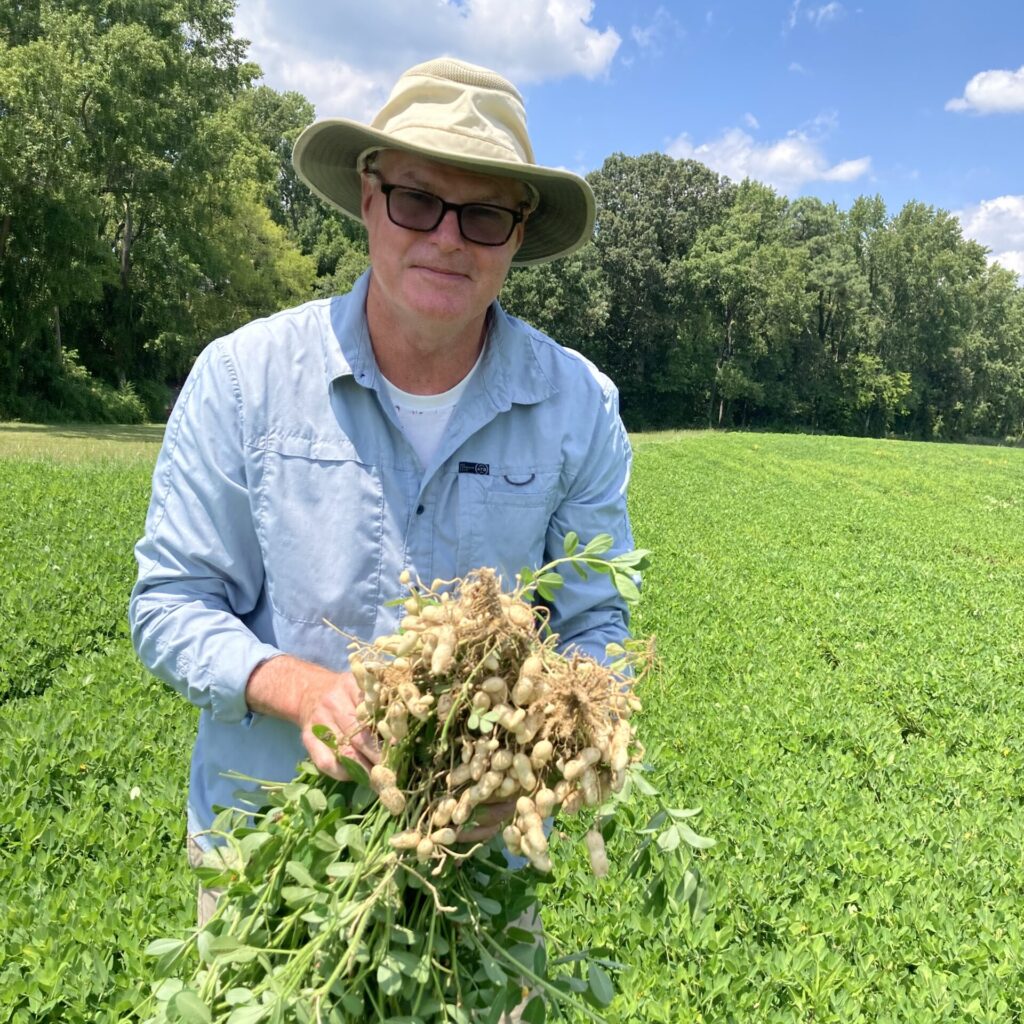
As we move into harvest season, the phrase “slow down” is not what we want to hear, but we know that letting peanuts reach optimum maturity pays when it comes to yield and market grades. For Virginia market types, the general estimate is an increase in yield by one percent per day as you move from three weeks before optimum maturity to optimum maturity. There are some general thresholds we use in North Carolina for other factors that might encourage us to dig earlier than what pod maturity suggests. Disease is one factor. On our peanut profile charts, we state the following:
1) Do not dig early if you have tomato spotted wilt.
2) Dig at 40% defoliation caused by leaf spot disease regardless of pod maturity.
3) Dig at 50% incidence (percent of peanuts with signs of disease) for Sclerotinia blight and southern stem rot regardless of pod maturity.
4) Dig at 40% incidence for black root rot (CBR) regardless of pod maturity.
We don’t have a percentage for spider mite injury, drought, or nematodes. Often, the impact of spider mites and nematodes is spotty across fields, and we don’t see defoliation and subsequent pod shed. It’s better to let the healthier plants and their pods advance in maturity. Some of the pods on injured plants will also gain weight. For drought, if some plants are brown and they look dead, you also need to balance what’s going on with other areas of the field that might be stressed but still have a lot of life in them. If kernels are rattling in the hull, maturity is done. But how do you determine the percentage of pods that are rattling? We’ve struggled to know what to recommend when it comes to that.
During the week of Aug. 31, I had discussions with folks about moderate and severe drought stress in North Carolina. Some folks were ready to dig that week, but they decided to delay digging. On Friday night of that week, we received anywhere from a quarter-inch to several inches of rain. This rain will help push maturity along even for the stressed peanuts. It won’t be a miracle, but it will be a substantial improvement. It will also help folks successfully dig strip-tilled fields in the area with much less pod loss.
The discussion about digging early for disease brings in a lot of strong opinions. We are looking for a reason to move forward with digging. There is a lot on the line. We do know that our eyes pick out the bad in fields this time of year. What we might call a field “eat up” with disease and estimate to be 50%, may only be a field with a lot of disease, and when we are able to take the time to accurately quantify the amount, the number may be closer to 10%-15%. We need to muster as much patience as possible when we are considering digging early based on disease.
The other part of “slow down” is the speed at which we dig and pick. Any speed over two to three miles per hour (closer to two) can result in measurable yield loss during digging and vine inversion. The same can be said for harvesting. We can create more damage and lower grades when we rush and speed up equipment.
I’m definitely a research and Extension person in North Carolina. While a grew up on a farm, I am not farmer. Check with folks more local to you on the recommendations I have provided. You have a lot to deal with on your farm. For every acre of peanuts, you probably have three or four other acres of something. I’m focused almost exclusively on peanuts. With that said, we do gain a lot by having patience and slowing down as much as possible. I hope you can do so and get more out of your peanut crop in 2026.
We use cookies to ensure that we give you the best experience on our website. If you continue to use this site we will assume that you are happy with it.