

By: Ibukunoluwa Adelekan, Sarah Beth Thompson, and Wesley Porter
Harvest for peanut s has already started in the earlier planted peanuts across the state. With the later plant dates on the decline from peak water usage, the earlier plant dates are either being harvested or on the last few irrigation events before digging. It is important not to terminate irrigation across all fields at once and to not fall behind on irrigation, especially in the later plant dates. It seems this season as we have received rainfall several times it has been in large rain events. When these heavy downpours happen, we need to keep in mind two things which impact how much of that rainfall we capture and are able to utilize for our crops. These items are the water infiltration rate and water holding capacity of our soils. When we receive those 3” rainfall events we may only infiltrate or “bank” 0.75” or 1” of it according to rainfall intensity and soil conditions. Thus, a singular rainfall event across a week or longer will not be adequate and irrigation will most likely be needed.
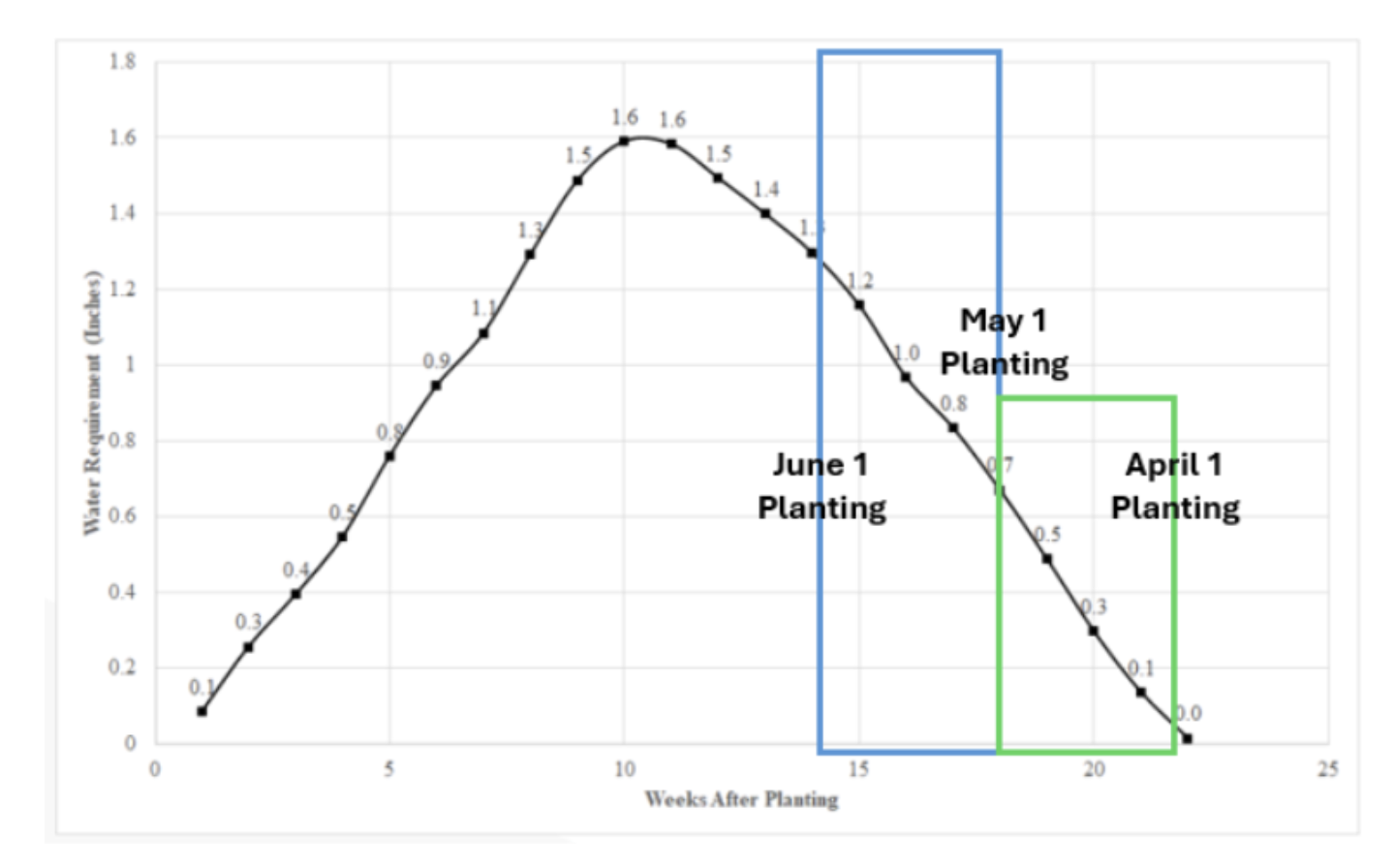
Unlike other crops, peanuts do not have a specific time to terminate irrigation. Following the crop production guide, at 120 days after planting (DAP) maturity checks are recommended. Once the crop reaches maturity, irrigation can be terminated. For most runner peanuts, “optimum maturity” is at or around 140 DAP. However, we know that some of the new varieties have longer maturity dates. For maturity date ranges for your specific varieties refer to page 40 of UGA Peanut Production Field Guide.
April 1 Planting |
162 DAP |
May 1 Planting |
130 DAP |
June 1 Planting |
101 DAP |
Late-Season Peanut Irrigation Observations: Camilla, GA
Peanuts at SIRP were planted on May 18 and are at 112 DAP on September 8th. At this point in the season, water use is coming down, and attention is starting to shift toward maturity, digging, and harvest. Irrigation still needs to be watched closely, especially when September stays hot and dry. UGA guidance cautions against cutting irrigation too early because peanuts may still have several weeks of development left before they are ready to dig.
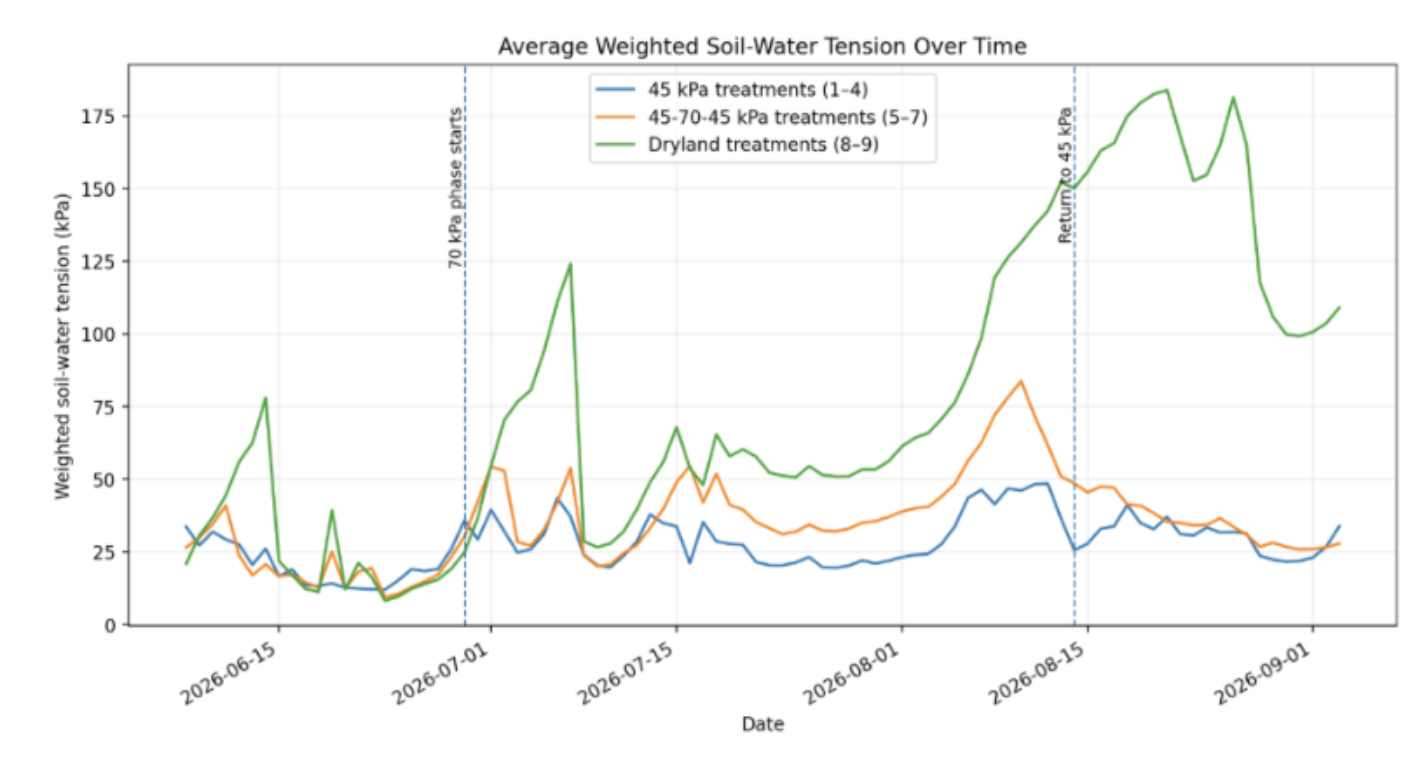
This study focuses on irrigation timing and PGR management. The irrigation treatments vary based on the current recommendation of using soil moisture sensors at 45 kPa and implementing a drier soil condition from 40-85 DAP at 70 kPa. The treatments with the drier soil condition applied averaged about 3.50 inches of irrigation, compared with 5.25 inches for the corresponding 45-kPa treatments. That comes out to about 1.75 inches less irrigation, or roughly 33% less water during that period. Yield data will be collected at the end of the season to see whether that difference came with a yield reduction. In addition, the soil water tension graph below shows that the drier treatment (orange line) stayed at a much drier level during the middle of the season and has just now recovered due to recent rainfalls.
The weather helps explain what happened in the field. From June 1 through September 3, rainfall did not keep up with ET at any of the three locations we checked. Camilla had the largest deficit, with ET exceeding rainfall by 7.74 inches over this time period. Stored soil water and irrigation also contribute to crop water supply, so this is not the same thing as saying the crop experienced a 7.74-inch deficit. It does tell us that rainfall alone was not enough to match atmospheric demand. This is also where irrigation management can be tough, even if you are irrigating on a regular basis, sometimes we cannot keep up with irrigation alone.
Location |
Precipitation (in) |
ET (in) |
Water Balance (in) |
Camilla |
12.11 |
19.85 |
-7.74 |
Tifton |
15.44 |
19.69 |
-4.25 |
Unadilla |
14.26 |
18.85 |
-4.59 |
