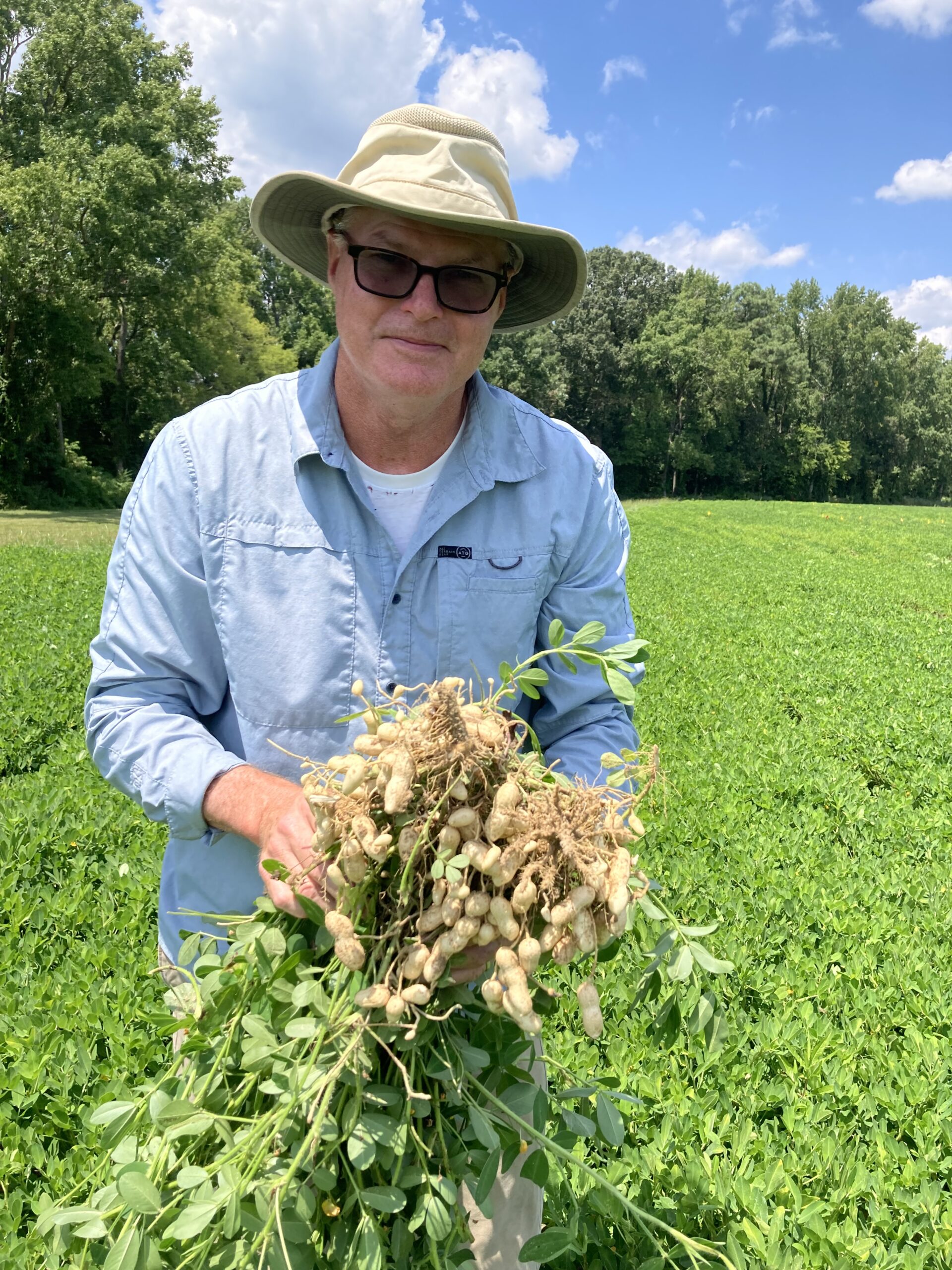
This time of year, a major focus is on preparing and entering the harvest season. One of the most important decisions is related to when to start digging and inverting vines. Determining the maturity of pods, a reflection of the maturity of kernels and their weight, is one of the pieces of information to consider when scheduling a field for digging. Extension services around the country can provide you with maturity profile charts that can help with this decision. There is no substitute for collecting representative pod samples and looking at the pod mesocarp layer to predict when peanuts will reach optimum maturity. The pod blaster (pressure washer with a rotating nozzle), a pocketknife, or fingers that are capable of shelling a peanut to expose the endocarp (as the kernel matures, it will rub against the endocarp and eventually expose the mesocarp from the inside of the hull) are the three ways one can assess maturity of a sample.
However, we long for a consistent method that can remove the subjective nature of laying pods on a chart or tailgate and deciding. Days after planting and heat unit accumulation can be good estimators. There are some potential weaknesses in these approaches. Days after planting do not take into account how long it took for peanuts to emerge. We know we have variation from year to year, field to field, and across planting dates within or across fields. Heat unit accumulation can be a good indicator, but in my experience, it may suggest that pods are mature based on “established criteria;” however, the assumptions for the “established criteria” may not hold from field to field. Recording heat units from the day peanuts emerged is important as a starting point. The challenge with heat units as the indicator is that sometimes we accumulate a lot of heat, but dry conditions prevent the crop from advancing. To me, the heat unit number often discussed for a variety is almost always on the early side of optimum maturity. When the crop finally reaches optimum maturity, it is most often later because of stresses we may have had. But heat unit accumulation does help us understand when we need to get ready to sample and make sure equipment is ready to go.
If you are not familiar with heat unit accumulation for a day (also called a growing degree day), it is calculated as the average temperature for the day minus 56. We assume if temperatures are below 56, peanuts do not progress. That is our base. While I’m not always good at doing so, once we hit 95, the plant is often stressed by excessive heat. We should have 95 as ceiling. From a calculation standpoint, if the daily high is 90 and the daily low is 70, the average of these two numbers is 80. When 56 is subtracted from 80, we observe a heat unit accumulation of 24 for that day. This number, plus all the others accumulated since the peanuts emerged, gives us a snapshot on where we are, and we can use this to estimate when we might arrive at optimum maturity.
To drive this point home, I looked at heat unit accumulation since May 1 (assuming peanuts emerged that day) for a location in North Carolina on Aug. 14, and the value was 2277. Based on previous research on our most popular Virginia market type (Bailey II) in North Carolina, we need to reach 2600. Peanuts would need another 323 heat units, and if I assume accumulation is about 20 per day, we are about 16 days away from optimum maturity. This would be the earliest possible date for optimum maturity. It’s almost a given that it will take more time because of less-than-ideal weather at various points during the season. Also, will the 20 days hold constant over the next few weeks? This is an unknown.
There are several data points to use when predicting when a field will reach optimum maturity. The number of days and heat units are helpful, but we still need to look at the pod mesocarp color from a representative sample several times to fine tune the decision. It’s an important decision — we gain about 1% in yield per day if we can wait until peanuts are at optimum maturity. A key to using this number (1%) is having a good way to make the prediction. There are a number of researchers looking at more in-depth models and remote imaging to see if those tools can make this process easier. However, for now, looking at pod mesocarp a couple of times is the most reliable approach to estimate when optimum maturity will occur.
We use cookies to ensure that we give you the best experience on our website. If you continue to use this site we will assume that you are happy with it.