The Chemistry Of Taste: Researchers Seek The Chemical Clues That Make A Tasty Peanut
MARIA M. LAMEIRAS
ATHENS, GEORGIA
Georgia grows more peanuts than any other state in the country. But for the breeders developing the next generation of varieties, some of the most consequential work isn’t happening in the field – it’s happening in the lab, where a team of University of Georgia scientists is working to take the guesswork out of roasted peanut flavor.
The challenge is a familiar one in crop breeding: Flavor matters enormously to consumers, but it’s one of the last things breeders can afford to test.
Conventional sensory evaluation – the gold standard for measuring roasted flavor quality – either requires a trained panel of 8-10 people or a consumer panel of 100 people, both of which are time-, material- and cost-intensive tests. In a breeding program where promising lines are still being grown, a handful of seeds at a time, that’s simply not practical.
That’s where Joonhyuk Suh comes in. Suh, a food chemist and an assistant professor in the Department of Food Science and Technology, is leading a multidisciplinary team, including Brown, food microbiologist Abhinav Mishra, and sensory scientist Koushik Adhikari, to build a predictive model that can evaluate roasted peanut flavor using chemical data alone. If it works, the required sample size drops to a fraction of what sensory evaluation tests require – roughly one-tenth – and the analysis could be applied as early as seedling trials.
“In the early stage of breeding, when sample quantities are too limited for sensory evaluation, we could identify those compounds and predict the flavor quality from chemical analysis,” Suh said. “Sensory evaluation will still be essential downstream, but this gives breeders a way to screen promising lines years earlier than they can today.”
The science behind the model hinges on two classes of chemicals. The first are volatile aroma compounds, the molecules directly responsible for the smell and taste consumers associate with roasted peanuts. The second are their precursors: sugars and amino acids that react and break down during roasting to produce those aroma compounds.
Leading the experimental work is Namhee Lee, a doctoral student in Suh’s lab, who is responsible for the experimental design, chemical analysis and data interpretation behind the project. She is also building initial prediction models from her experimental data, which feed into a broader machine learning comparison led by Mishra.
“Connecting the chemical changes during roasting to what the sensory panel perceives is what will make the prediction model work,” Lee said.
The team is analyzing both raw and roasted peanuts to identify which sugars and amino acids are consumed most heavily during the roasting process. Those are the likely precursors. They have already completed sensory evaluations and chemical analyses on an initial set of three cultivars selected to represent the full range of roasted flavor quality – from excellent to poor – and are now in the statistical analysis phase, looking for the compounds that consistently separate the excellent samples from the poor ones.
“When people perceive flavor, that perception is derived from chemical compounds,” Suh said. “The problem is we don’t know exactly which compounds contribute to certain flavor. That’s our goal.”
Mishra, whose background is in mathematical modeling and food safety, is building three parallel models: one using aroma compounds and precursors together, one using aroma compounds alone, and one using only sugars and amino acids. Comparing the performance of all three will reveal which chemical profile is the most reliable predictor of sensory quality.
“My role is to build machine learning models that look for correlations between the chemical data and the sensory results, essentially asking whether certain amino acids or other compounds are driving or diminishing the qualities that consumers perceive,” Mishra said.
Matching industry benchmarks with DNA-level breeding
For Brown, the practical payoff is clear. The benchmark for roasted peanut flavor in the industry is ‘Georgia-06G’, a UGA-developed runner variety released in 2006 that remains the most widely planted peanut in the United States. His breeding program’s goal is to at least match that flavor while improving yield and disease resistance – but by the time flavor testing is feasible in the conventional pipeline, a breeder has already invested years in a line.
“It would really help if we had a cheap, fairly accurate way to test small quantities of seed,” Brown said. “If we had a method to check for flavor through the process, maybe we wouldn’t have to spend so much money testing things that don’t have good flavor – we could drop them from the program very early.”
The project, which began in October 2024, received initial support from UGA’s Institute for Integrative Precision Agriculture and the National Peanut Board. A $650,000 proposal to the U.S. Department of Agriculture National Institute of Food and Agriculture is pending. If funded, the team plans to expand testing from fewer than 10 cultivars to more than 100 and to identify the genetic markers tied to flavor-related compounds, moving beyond variety selection and toward DNA-level breeding decisions.
For now, the team is working toward a prediction model with high accuracy – a level Suh says is achievable and would open the door to using the tool with newly developed varieties across the UGA breeding pipeline and, eventually, across the USDA’s broader peanut variety database.
“Once we get a solid prediction model,” Suh said, “we plan to use it for new varieties being developed – not just UGA varieties, but peanut varieties from across the country.”
MARIA M. LAMEIRAS
UNIVERSITY OF GEORGIA
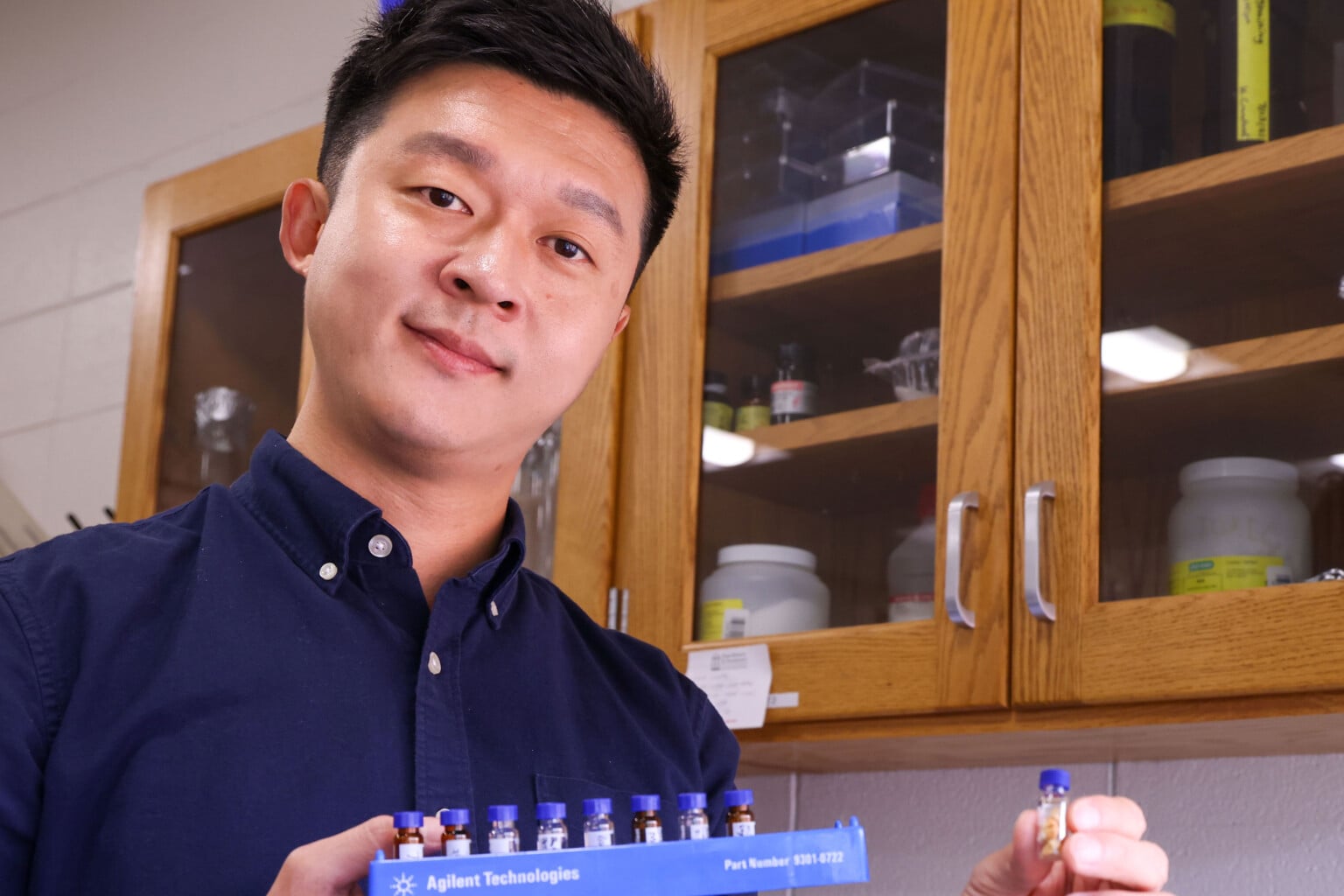
Joonhyuk Suh, a food chemist and assistant professor in the UGA Department of Food Science and Technology, is leading a multidisciplinary team to build a predictive model that can evaluate roasted peanut flavor using chemical data alone. (Photo by Caroline Newbern)
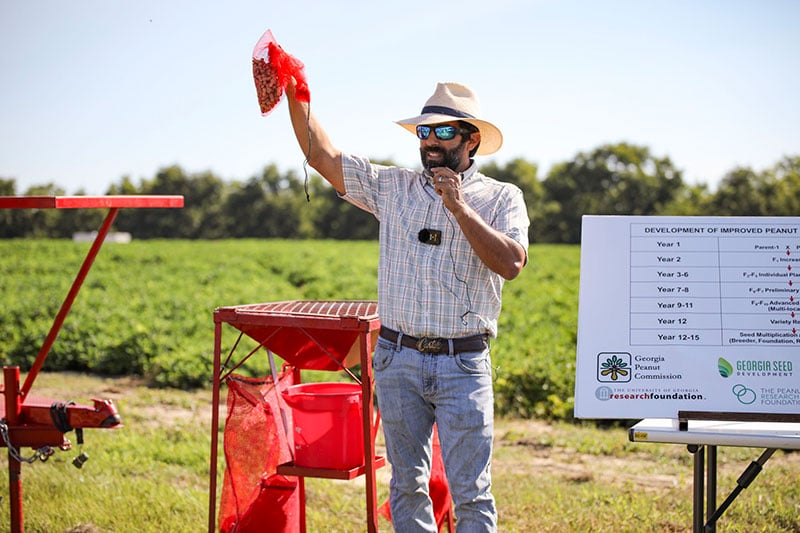
Peanut breeder Nino Brown will use data from the research to develop better, faster, cheaper methods of understanding flavor in breeding lines. (Photo by Maria Lameiras)
Food microbiologist Abhinav Mishra is developing three parallel machine learning models to identify correlations between chemical data and consumer sensory perception. (Submitted photo)
“Once we get a solid prediction model,” Joonhyuk Suh said, “we plan to use it for new varieties being developed — not just UGA varieties, but peanut varieties from across the country.”
Link to Original Article: https://fieldreport.caes.uga.edu/news/chemistry-of-peanut-flavor/?utm_source=CAES+Newswire&utm_campaign=beec4e86b3-Newswire_Media_Daily&utm_medium=email&utm_term=0_4cb3048305-beec4e86b3-451574296
We use cookies to ensure that we give you the best experience on our website. If you continue to use this site we will assume that you are happy with it.